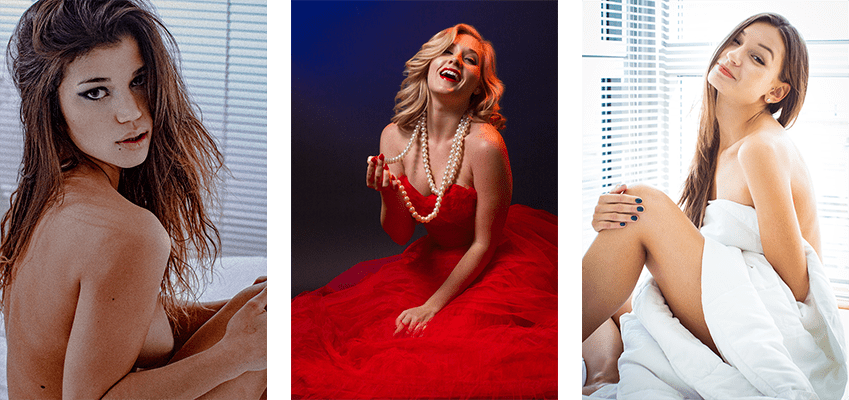
Whether your portrait subject is a client or a collaborator in your next artistic vision, it’s very important to get them excited and on board with your ideas for the shoot. They are the actor in your drama, the star of your movie, even if your “theater” is only an ad-hoc studio setup, your subject’s confidence and enthusiasm are key ingredients for a successful shoot.
It’s not always necessary but it can definitely make a difference to turn a portrait subject into a creative partner who shares your goals for an inspired set of images. Successful portrait photography is just as much about psychology as it is about using your camera. In this chapter, I offer a few tips on getting the most from your subject by inspiring confidence and enthusiasm.
One thing you can do is prepare a set of reference images that will help you communicate your ideas for the look and feel you’re going for. Gather them from any source — magazines, websites, or your own portfolio — and show them to your subject. Maybe one of the images contains an element or style that helps explain a feeling you’re trying to evoke. Another might help describe a look or pose that comes close to the idea you’d like to try. When you’re dealing with clients, a set of reference images is a good way to zero in on the type of shots desired.
Another technique to use with models and clients is to communicate ideas for the look and feel of the images using simple adjectives. I like to use non-photographic terms, especially with clients, to communicate a sense of what the pictures should look like when finished. For example, I ask my boudoir clients to tell me what words they’d use to describe how their photos should look. I give them a list that includes words like coy, sensual, strong, playful, sultry, and sophisticated, and ask them to pick the ones that match up to what they’re looking for.
It’s always best to talk over ideas to find out if your client or model is comfortable with the looks you want to portray. If your pictures will be a little racy or feature nudity, for instance, you’ll want to make sure your subject is comfortable with the ideas so neither of you feels awkward or surprised during the shoot.
Ask your subject to share any ideas they might have, too. I can’t tell you how many times I’ve been surprised by the ideas my models and clients sometimes come up with. Someone you might have pegged as very conservative or traditional might suddenly come up with a very off-the-wall idea that turns out amazingly well. I love surprises like this!
Photography has a way of giving people permission to express themselves in ways they might not otherwise. If you’re open to ideas, and your subject knows they can trust you, you never know what kinds of images you might get out of a shoot for both of your purposes. This, of course, depends on the subject’s willingness to allow you to use or show the images in your portfolio. Without that permission, all you’ll have is the experience of taking the pictures, and possibly something to build on for ideas for a future shoot.
Make It Personal
Photographing the things and people most important to you is probably what got you interested in photography in the first place. This is something that you should never stop doing. You’re the photographer around your friends and family so you have license. Why not use this special and intimate access you have in order to create the most personal imagery possible? Photographers like Elinor Carrucci, Phillip Toledano, Sally Mann, Annie Leibovitz, Nan Goldin, and many others have made some amazingly intimate and beautiful work this way.
Family and the People Closest to You
Your first and most deeply affecting relationships are with your family members. From the most cherished and positive relationships, to the heartbreaking, to the downright dysfunctional, they are all in some way significant. For the photographer and artist in you, these familial relationships can provide a wealth of material to draw from for posed as well as candid portraits.
For your would-be subjects, understand that having a photographer in the family can be at times very convenient and at other times very annoying. But everyone’s got something that’s a little annoying, and we all just learn to live with it because it’s part of who that person is. If your thing is that you’re always taking pictures, even when it seems odd or inappropriate, that’s just something people will eventually get used to. Of course, there are limits and boundaries, but you’ll have to figure out what those are where your family is concerned.
Whether it’s with family or friends, there’s a rhythm you’ll find to photographing the people in your life. At some point, they will realize that they’re not expected to stand and smile for every picture. They’ll start to understand that your camera is just something you use to see with like some people use reading glasses. You use your camera as one way to pay attention, then you put it down when you’re done. They’ll get used to it.
Don’t give the people in your life a reason to view your camera as a weapon, or as a means to embarrass them. Candid photography should be seen as a thing you just do almost as if it were a completely normal thing; like using a cell phone to capture a moment. Posed portraits can be created almost as uneventfully as your candids, or you can approach them as a special moment.
Don’t Make It Sound Intimidating
You might think saying, “Let me take a quick portrait of you,” is a harmless enough request. But just the word, “portrait,” can conjure up a sense of formality that most people are a little uncomfortable with. At any given moment, you might see a beautiful portrait ready to be taken right in front of you. But, the subject might feel put on the spot and anything but prepared.
The people who care for you know that photography is important to you and don’t want to disappoint you with how they think they’ll appear in your pictures. They also don’t want to be harshly judged on their appearance in a “real portrait” where they feel the expectations are higher than they would be in a casual snapshot. You’ll have to learn how to reassure them, keeping their concerns in mind.
You might start by not using the word “portrait” at all and opt for something more benign like “picture.” Just remember not to put too much weight on an impromptu sitting. There’s nothing wrong, however, with making a special occasion out of a portrait, if the subject is willing.
The Basic Portrait Setup
I teach you how to put together a lighting setup in my skills courses, along with the core message of how to standardize your working methodology. I understand how this might sound contrary to much of the advice I give in this and other books I’ve written. After all, how can someone who so strongly advocates experimentation and bucking the conventional suggest that you actually build convention into your process?
To get to that answer you’ll have to understand that I recommend using a methodology as a creative tool, as a way to set yourself free of technical concerns when it matters most. It’s not the only way to shoot, but it can be one of the best strategies for making great pictures almost effortlessly.
If you’ve ever spent time worrying about camera settings and lighting setups during a shoot you’ll know what I’m talking about. These moments of taking your attention off your subject and breaking a free-flowing rapport can set back a shoot and spell the difference between a great portrait and a mediocre one. The fewer details you have to concern yourself with during a shoot, the more relaxed and smooth it will be. Imagine how much you could get done if your camera and lighting just seemed to magically take care of themselves. No worries about settings, metering, light positions, and distances, while you simply and confidently converse, direct, and click the shutter, knowing that the majority of the images you take will be wonderfully exposed with perfect lighting.
This is the ideal that you should strive for as you build a simple and effective go-to portrait setup of your own. You should become so familiar with every part of your setup that you can literally put it together with your eyes closed. Whether your basic portrait setup is a one-, two-, or three-light setup, you should have each setting on each individual light committed to memory.
Start with the same lens and same camera settings each time. Perhaps there’s a particular background or sitting stool or some other element to this setup you always want to include. Whatever your setup consists of, the idea is that it ALWAYS gets set up the same way and you ALWAYS begin your shoot with the same camera settings. You should be able to set this up in less than five minutes without having to make any on-the-spot decisions. Then you should be able, using your predetermined camera settings, to take the first shot with complete confidence that it’ll be correctly exposed.
Should this be the only way you shoot? Absolutely not. But this is an excellent way to make sure, that under any circumstances, you’re able to get great portraits without even thinking about the gear. At the very least, you’ll be confident that your portraits will be technically good. Then, the only other thing you’ll have to deal with is the subject themselves. That’s what makes working like this so incredibly powerful. Your mind is free of technical concerns and all you have to do is take the pictures! Take advantage of this, turning a self-imposed set of constraints into total creative freedom.
How many different looks can you pull from your subject using this one simple setup? How far can you push the creative envelope? It’s all on you now. You can’t shift the blame on lighting challenges or camera settings, or lenses when all of that was worked out prior to the shoot. The object of this exercise (and working methodology) is to show yourself what is possible when you’ve got very little to work with. It’s a great confidence booster when you know, going into a shoot, that its technical success has already been worked out. If you start off your shoot with a predetermined setup, you can easily progress into a lighting configuration more customized to the situation or adapt it for any creative ideas you come up with. It’s a matter of starting with something foolproof and just tweaking it to make it better. Your standard setup can be anything you want it to be. But I suggest you start off with just one or two lights, eventually moving to a third if absolutely necessary for the type of portraits you want to produce consistently.
How many different looks can you pull from your subject using this one simple setup? How far can you push the creative envelope? It’s all on you now. You can’t shift the blame on lighting challenges or camera settings, or lenses when all of that was worked out prior to the shoot. The object of this exercise (and working methodology) is to show yourself what is possible when you’ve got very little to work with. It’s a great confidence booster when you know, going into a shoot, that its technical success has already been worked out. If you start off your shoot with a predetermined setup, you can easily progress into a lighting configuration more customized to the situation or adapt it for any creative ideas you come up with. It’s a matter of starting with something foolproof and just tweaking it to make it better. Your standard setup can be anything you want it to be. But I suggest you start off with just one or two lights, eventually moving to a third if absolutely necessary for the type of portraits you want to produce consistently.
For inspiration, see the work of great photographers like William Coupon, with his iconic portraits featuring the same types of backgrounds and single light sources, or Platon who tends to use a simple and consistent style of lighting. These photographers and others who have become known for their signature styles have one thing in common: they have mastered a way of lighting that allows them to get the consistent and beautiful results they want, every time. Certainly, any good photographer can sculpt light as they see fit, but most need plenty of time, metering, and testing in order to pull it off with any confidence. The best have learned to leave little to chance where technical issues are concerned.
Remember that your setup can be anything that you’ve decided to use regularly, even constant lights, or on-camera flash. But whatever it is, make sure that it is something that would be almost impossible to make a mistake with and doesn’t rely too heavily (if at all) on exposure variables or other changing conditions. This is as close as you’ll get to a sure thing.
Set Limits for Better Results
When you’re doing something you love, it’s easy to lose yourself in the process. I’ve done shoots where the subject and I both completely lose track of time because we’re really focused and having fun. But it’s important to be fair to yourself (especially if you’re shooting professionally) and everyone else involved in your work, or anyone who’s affected by it, like family. Setting limits on things like time, effort, and expense will save you a lot of grief as well as help maintain a state of balance in your work and life.
Setting Limits For Yourself
I’ve always found the most productive and enjoyable shoots are the ones that didn’t go on for more than two or three hours and were shot at a relaxed pace. Some of my best shoots were well-planned and conceptualized, and some were completely spontaneous and improvised. But they all had a couple of things in common: they didn’t drag on for too long and I shot on average about ten frames per idea or look. When I work this way it allows me to really take my time with every aspect of a shoot giving me a chance to make each individual shot count.
Another benefit is that I end up with fewer images to deal with in post, and most of those I’m very pleased with. This saves me some valuable time on the back-end. It’s much better than having rushed to try too many ideas and looks, or having shot too many frames for each look. Ending up with thousands of useless or mediocre shots to cull and salvage from is no fun.
Giving yourself a reasonable time limit for the entire shoot, and keeping mindful of the number of shots you want to end up with will help you do a better, more thoughtful job resulting in better images to choose from and less work after the shoot.
Setting Limits For Others
Realize that many of the people who pose for you aren’t professional models and they need guidance when it comes to just about everything concerning a shoot. Establishing limits is important to make sure you and your subject have the best chance of achieving your goals by the time you’re done taking pictures. Most people, for instance, overestimate their ability to go for more than a couple of hours in front of the camera. And there are others who just want to keep going for much longer than necessary, potentially wasting your time during the shoot — and on the back-end when post-processing and editing time come into play — and adding to the overall expense of the shoot.
Some areas where you should consider setting limits include:
Photography Time. Each subject has a different threshold for how much camera time they can comfortably handle. In my experience, the lower limit is around 45 minutes. The upper limit is about two-and-a-half hours. If you continue shooting once you’ve crossed your subject’s tolerance threshold, it’ll show in the pictures. It might also make your subject less enthusiastic about working with you in the future. It’s always better to end the shoot with both of you wishing you could go on, rather than feel like you’re glad that it’s finally over.
Makeup & Hair. Depending on the type of shoot, your subject might be having hair, makeup, or some other styling taking place before arriving at the shoot location. Hairstyling and professional makeup application could take up to 2 hours or more. Setting time limits here is not always possible, especially if the makeup artist and/or stylist is off-site and not working under your direction. These professionals are just as likely to require more time than they estimate to complete their jobs as anyone else involved, so plan for that. If they are working under your supervision, let them know what you need from them in terms of the time it takes to prepare one or more looks, and how, or if, they will be used during the actual photography (for touch-ups, etc.).
Wardrobe Limits. This is an area where most people overestimate what is reasonable to attempt for a shoot. Your subject might bring several outfits hoping that they can be photographed quickly in each one. But they’re probably not experienced enough with photo shoots to realize that more goes into getting a variety of shots than just changing outfits. Depending on the kinds of clothing they’ve brought along, there might be things to lace up, seams to line up, straps to straighten and adjust, and tags and threads to be clipped off any just-bought items. There are also going to be accessories to consider, and possibly hair and makeup changes.
For a two-hour shoot and four distinct looks, with an average time of 15 minutes for each change, that leaves you with only about 15 minutes to shoot each look. If you want to try more than a couple of poses, perspectives, and possibly even some lighting changes for each outfit, that doesn’t leave you much time to work with.
Other Things to Watch Out For
I’ve had editorial jobs and paying clients who want to keep a shoot going over many hours and/or locations for one reason or another. I always try to make a shoot fun, but sometimes I guess it’s just so much fun that the subjects don’t want to see it end. This can be a big problem for a number of reasons, but suffice it to say that there’s a point in time when the productive period of a shoot comes to an end, and anything after that is at the very least a waste of time and money, and potentially even counterproductive to the entire job.
Again, it’s very important that you and your subject or client agree on the time and duration of the shoot before the shoot date. Also, make it clear to them that you must be finished by a certain time, so any delays will cut into the photography time. The vast majority of people will set aside enough time in their day to make sure they are ready, on time, and available for as long as you feel is necessary to get the pictures needed. But you should protect yourself from the ones who are less considerate of your time by making it clear that it is limited.